01 / signal
Persisted token-ID tables select residual capacity.
Each layer stores a 2 × 32,000 route table that selects two distinct experts. The released checkpoint has no learned router or channel modulation.
Loading Complexity
complexity.deep / routing
We build inspectable transformer systems around deterministic token routing, shared expert capacity and executable open-source tooling.
201.2M
parameters
≈162B
source exposure
32K
vocabulary
top-2
hash routing
token_id
stable identity
route_table
fixed assignment
expert[e]
residual path
def route(token_id):
# fixed, inspectable, no learned gate
return shared(x) + experts[table[token_id]](x)
[Research / source of truth]
01 / signal
Each layer stores a 2 × 32,000 route table that selects two distinct experts. The released checkpoint has no learned router or channel modulation.
02 / capacity
Every token keeps the shared SwiGLU path, while both selected experts transform the same contextual hidden state.
03 / audit
Direct inspection finds 492,097,536 trainable parameters, 24 distinct route tables, no duplicate top-2 routes and exact marginal expert balance.
04 / result
The final checkpoint is step 76,293. The last scheduled held-out evaluation at step 76,000 records NLL 2.661519 and perplexity 14.32.
Scope guardrails
what the result does not claim
[Open-source stack]
Released full-parameter SFT
The released 32,000-token assistant cited by the public preprint: 201.2M parameters, a complete 130B base run, 32.07B refinement exposures and three epochs of full-parameter SFT.
Visual architecture laboratory
Build, inspect and execute PyTorch architectures as typed atomic graphs—with an agent that uses the same visible tools.
Interactive object detection
Run the compact hash-routed COCO detector on your own image, or draw a new example from 100 shuffled validation images without repeats.
Serving engine
Paged KV cache, continuous batching and an OpenAI-compatible API for token-routed inference.
Hugging Face organization
Every TR-Hash checkpoint, dataset and Space we publish, in one place — see /models on this site for the current releases with their real numbers.
PyTorch foundation
Canonical TR-Hash MoE execution, multi-hash routing, GQA/MHA decoders, CUDA paths and full-parameter pretraining, refinement and SFT.
[Inference / evidence]
8,078tok/s
10,179tok/s
29.3ms
100req
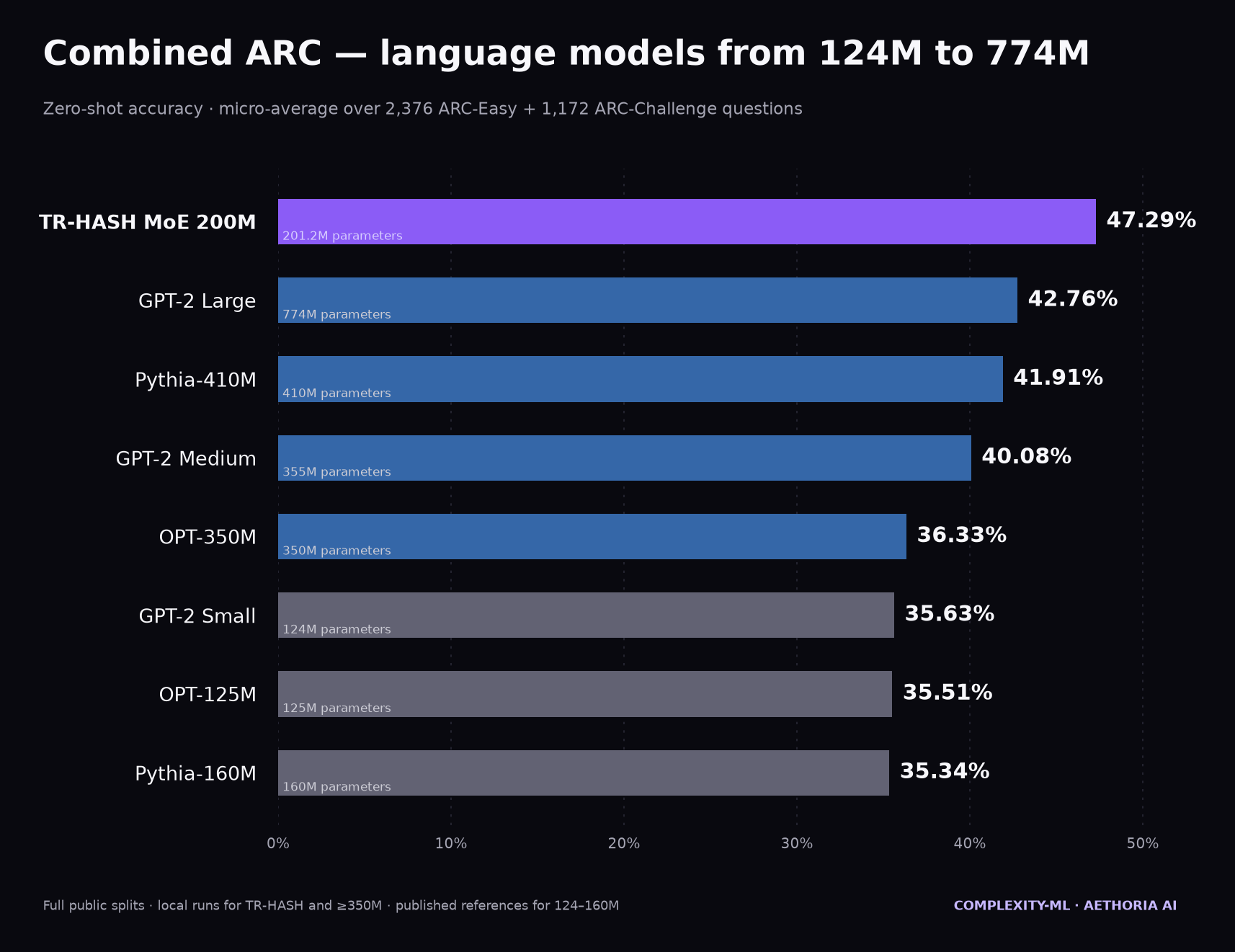
combined_arc_model_comparison.png
Full ARC public splits · zero-shot causal-choice · 201.2M versus 124M–774M
[Full-SFT expert geometry]
Each point is one of the two actual routed residual contributions for a sampled token. The shared MLP output is excluded; vectors are L2-normalized before PCA and 3-D t-SNE. Cluster separation remains exploratory and is not evidence of specialization or model quality.
download 6,000 points[Research reports]
Research Square preprint describing deterministic multi-hash routing, long-horizon training and the compact TR-HASH language-model experiments.
DOI10.21203/rs.3.rs-10788774/v1@article{Peyriguere_2026,
title={Deterministic multi-hash routing supports long-horizon training in a compact language model},
author={Peyriguere, Boris},
year={2026},
month={Aug},
publisher={Springer Science and Business Media LLC},
doi={10.21203/rs.3.rs-10788774/v1},
url={https://doi.org/10.21203/rs.3.rs-10788774/v1}
}A four-page report for the 2.53M-parameter hash-routed object detector: architecture, the two-stage from-scratch-pretrain-then-SFT recipe, and complete COCO AP results for both the one-to-many and NMS-free branches.
@misc{peyriguere2026trhashvision,
  title={TR-Hash Vision: Deterministic Spatial-Token Routing for a Compact Object Detector},
  author={Boris Peyriguere},
  note={Research report},
  year={2026},
  url={https://www.complexity-ai.fr/papers/tr-hash-vision-v8-sft.pdf}
}[About the lab]
Architecture choices, routing decisions and experimental caveats stay visible.
Code, model releases, measurements and hosted papers accompany the narrative.
Comparisons separate matched-token quality, training cost and serving throughput.